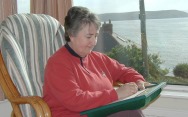

CHAPTER 11 – October 2002
10th October – Thursday
Yesterday I went to Exeter to see the neurologist. The week leading up to this appointment has been a bit difficult due to feeling unwell, partly due to apprehension and partly due to recovering from the weekend spent in Derbyshire. Having prepared myself mentally for a diagnosis of Multiple Sclerosis, which would determine some sort of treatment, I was almost disappointed to hear that although MS probably had a role to play it didn't explain the whole picture and that there was the possibility that there might never be a diagnosis. However, I can now look forward to having treatment anyway beginning with a few days in hospital, very soon, to have a steroid drip. I'm also to have another session in the 'washing machine' otherwise know as the MRI scanner. This time the rest of my central nervous system will be scanned. There is such a sense of relief to know that at last I shall be receiving some help and might be able to look forward to feeling a bit better.
Last year at about this time I was able to take my plastic Tupperware bowls and pick blackberries from a neighbour's hedge. This year even this small task is beyond my range. However this time of the year always brings back memories of collecting blackberries and rose hips from the hedges down various lanes near to the farm.
These days we take for granted the convenience of our various plastic kitchen aids. As a child I would either take a couple of enamel drinking pint mugs, an enamel basin or basket. When I was very small I might go blackberry picking with Granny and we would pick just enough for baking day when she would make several apple and blackberry pies. She was an excellent pastry cook. Even her cold pies were light and delicious. I would also take some back for Mam. She seemed to believe that economy was best served by having lots of substantial pastry with just a little fruit in the middle. She would never make the sort of pie that I loved. The best pies had only a lid, supported on an up-turned egg-cup and covering a deep dish full of hot fruit like Granny made. I don't think any of the family had the heart to criticise Mam's baking or perhaps we just didn't dare. It was never a good idea to hurt Mam's feelings as she had a talent for feeling hurt and ill-used. However, she did make excellent treacle toffee and flap-jack.
Gathering rose-hips came from an entirely different motivation. John and I would take our mugs and scour the hedgerows for these sizeable hips. It was essential that we did this together as I would pick the hips whilst he pulled down the high branches with a stick and held it at a reachable distance for me. We would take home our full mugs and empty the hips into a brown paper bag that we had brought home from school. The picking season was very short and it was vital that we didn't miss this opportunity to make some pocket money. We would take the bag into school as soon as it was full. Mr. Wright would weigh it on the scales and if it reached a certain weight we were given threepence and another bag to fill. In the decade and a half after the war there was a big push to build a healthy population of children and the rose-hips were sent away to make rose-hip syrup. I believe that nearly all our friends worked hard at picking rose-hips and there was quite a competition to who could fill most bags.
Strange as it may seem I can never remember having tasted rose-hip syrup although I may have licked the spoon after having dosed Richard, Andy and Peter when they were little.
Even by the time I left the village school this yearly activity had ceased. After the village school stopped taking our rose-hips Margaret, who went to The High School in Selby, would take our bags to a collection point somewhere near Selby Abbey. I can't think that there could ever be a cheaper way of harvesting the hips but perhaps it was just too messy to organise or perhaps the teachers found it to be a tedious exercise. However, I feel sure we learned some good lessons from rose-hip gathering not least the amount of work necessary to earn one's own money. The most difficult lesson for me was finding a way to get the paper bag to school without spilling any hips, getting the bag on to the scales and weighing it whilst Mr Wright looked on. I wonder if Kelly and Amy will ever experience the simple pleasures possible to children who live in the countryside. I'm in no doubt that the memories are more pleasurable than the actual gathering ever was. Blackberries left fingers and finger nails stained for what seemed weeks and every article of clothing bore the deep red stains of the berries. Rose-hips were just as bad as blackberries in that the bushes were thorny leaving us with scratched arms and legs. But I'm so glad to have these memories and life would be much narrower and poorer without them.
19th October – Saturday
After the heavy rains during the week the bright sunshine has returned but there is now the chilliness of Autumn.
This was the time for tidying up the farm, laying the hedges, draining and ploughing before the intensive activity of potato picking and drilling the winter corn.
Although I have no clear recollection of the preparations for bonfire night before I was ten or so I am sure that the celebrations of later years had their basis in earlier times. Bonfire night was a good opportunity to burn all the rubbish from the hedges and farm rubbish that had accumulated over the year.
The farming landscape took on a different perspective following the warm colours of the corn harvest. The land was ploughed and harrowed in preparation for next year's crops. Other than the bonfire field the stubble disappeared under the plough. Walking across the ploughed fields the thick wet earth would stick to Wellington boots making progress very hard. Picking 'fat ends' on the way through the beet fields would leave me soaked through. This was a particularly dirty time of the year.
If it seemed so to me how much more for Dad who would have to do the maintenance on any damaged drainage or put new in where there seemed to be flooding. There were no big machines for the job but just sheer physical hard work in areas which were cold from standing water or heavy with mud. He didn't seem to mind though. In fact he usually delighted in his various solitary jobs. The bright orange drainage pots would arrive and out would come Dad's various spades including a drainage one shaped like the pots which he would put in the ground. Because this was an annual job he would always know where a repair job was needed and where he needed to put in a new drain. These drains had to be deep enough in the earth to avoid being damaged by heavy machinery but not so deep that maintenance became impossible to carry out by hand. I remember looking on as Dad worked, finding out the broken pots and tidying up the drain where pots no longer met properly thus allowing water to seep out creating standing water in the field. I was particularly fascinated by the drainage spade and the shape it made ready for the new pot which I would pass to Dad when the earth was prepared. If I got wet and cold it was nothing to what Dad must have experienced standing and working in thick mud and cold water.
Dad can't possibly have liked draining though the satisfaction seeing a job well done would have given him a good deal of satisfaction I'm sure. However, he did love hedging taking great pride in the instant transformation made to the flat field landscape of our particular part of the Yorkshire countryside. None of us really minded the tidying up either which went to the building of the bonfire. There was always the right time to do things on the farm. Although it might seem early to be preparing for bonfire night the 'tatie picking' season was soon to be upon us and the intensity of getting them harvested as quickly as possible when the time was right was paramount.
26th October – Saturday
This week has been a terrible time for all the families who had planned a late holiday for school half-term. The weather has been wet and windy and there is nothing worse than being at the seaside in such conditions. Andy and Wendy took the girls to York for a three day break only to return after one night as Andy had to return to work unexpectedly to cover staff sickness.
We never considered the October break to be a holiday. In fact the term 'tatie picking week' described it perfectly. From way back in history schools in rural areas had to conform to the reality that children would be kept from school at this time of the year to work in the potato fields alongside the grown ups.
My earliest memories of tatie picking were of riding in a cart pulled by Bonny or Bluebell, our shire horses. I was allowed to ride on the horse from the stackyard to the field and afterwards on the way home. In the field the horse would plod up and down at a steady pace whilst Minnie, Jean, Dad and the Irish men would move along, bent from the waist, speedily collecting the potatoes and dropping them into their wire baskets. The Irish men who came over for the tatie picking season were tremendously thorough and fast at filling up their baskets. Once full they would throw the baskets into the cart where I would empty the baskets before passing them back. Everything had to be done at speed. Squib, Jean's husband, would be driving the tractor and spinning out the potatoes and there always seemed to be a frantic effort, on the part of the pickers, to keep up. The potatoes showed up best immediately they had been spun out of the ground. I suppose that was the reason for such furious activity. Even as I grew older I enjoyed the challenge of keeping up with the gang although we no longer had the Irish men which slowed things down a bit.
What was missed by the gang the first time round we youngsters had to pick later. Picking the 'arrowins' as it was called was a tedious job. There was none of the camaraderie that went with working as one of the gang. At first picking, only the big potatoes were gathered and baskets were filled quickly, but it was very tedious with the 'arrowins as the small potatoes often fell through the holes in the wire basket and the basket would seem so heavy for such a long time. No wonder I have suffered with a bad back for most of my adult life. I can remember clearly the only motivation for doing the farm work was to please the oldies.
The cart loads of potatoes would be taken back to just behind the cartshed where they were pied up to be sold later. Sometimes if the price was good they would be bagged up for a quick sale but often it was deemed more prudent to pie them up until the price went up a bit. The long pie would be covered with straw and earth. Farming was heavily subsidised in those days and sometimes the Ministry would offer a fixed price which we would accept. This meant the potatoes had to be marked with a blue dye and saved until such time as they were called on. This was a bit of a gamble and especially hard if the market price turned out to be high at a later date. I suppose this was a bit like the sugar-mountains and butter lakes of the later Common Market.
I vividly remember tatie picking down the lane at the back of the farm when I was ten. Bonnie and Bluebell had long gone to be replaced by tractor and trailor. It was the last year that Grandad had the farm although he had long since stopped working. Susan Bielby and I joined the others which included brother John and his friend Des. By this time John was driving the tractor and spinning the potatoes. We worked really hard and could now keep up with the best of them. Imagine our delight when we were paid 28/- for our week's work. I had never before been given such a huge amount of money and John was a bit put out that I had been given as much as him. But he always got the driving jobs from an early age and never really did the heavy work as Dad did or the drudgery jobs which often fell to me.
What to do with my new found wealth was the big question. Granny and Grandad suggested that I buy a Premium Bond. The government had just introduced this new scheme and the bonds could be bought for just £1 each. There would be a weekly or monthly draw, I can't remember which, with the possibility of winning a £1,000 or prizes right down to the value of £10. These would be listed in the newspaper. My first Premium Bond was AB 204---- and I remember the anticipation of waiting for the Saturday's newspaper to arrive. I never did win anything with that particular Premium Bond. As the years passed by it became impossible to buy them in less than multiples of ten. About twenty years ago I did win £50 that we shared between the five of us, John, Richard, Andy and Pete. Now I don't even know how many I have, where they are and whether they have my current address on. The big prizes are much larger now. Who knows, perhaps there is an unclaimed prize of many thousands of pounds waiting to be claimed.

